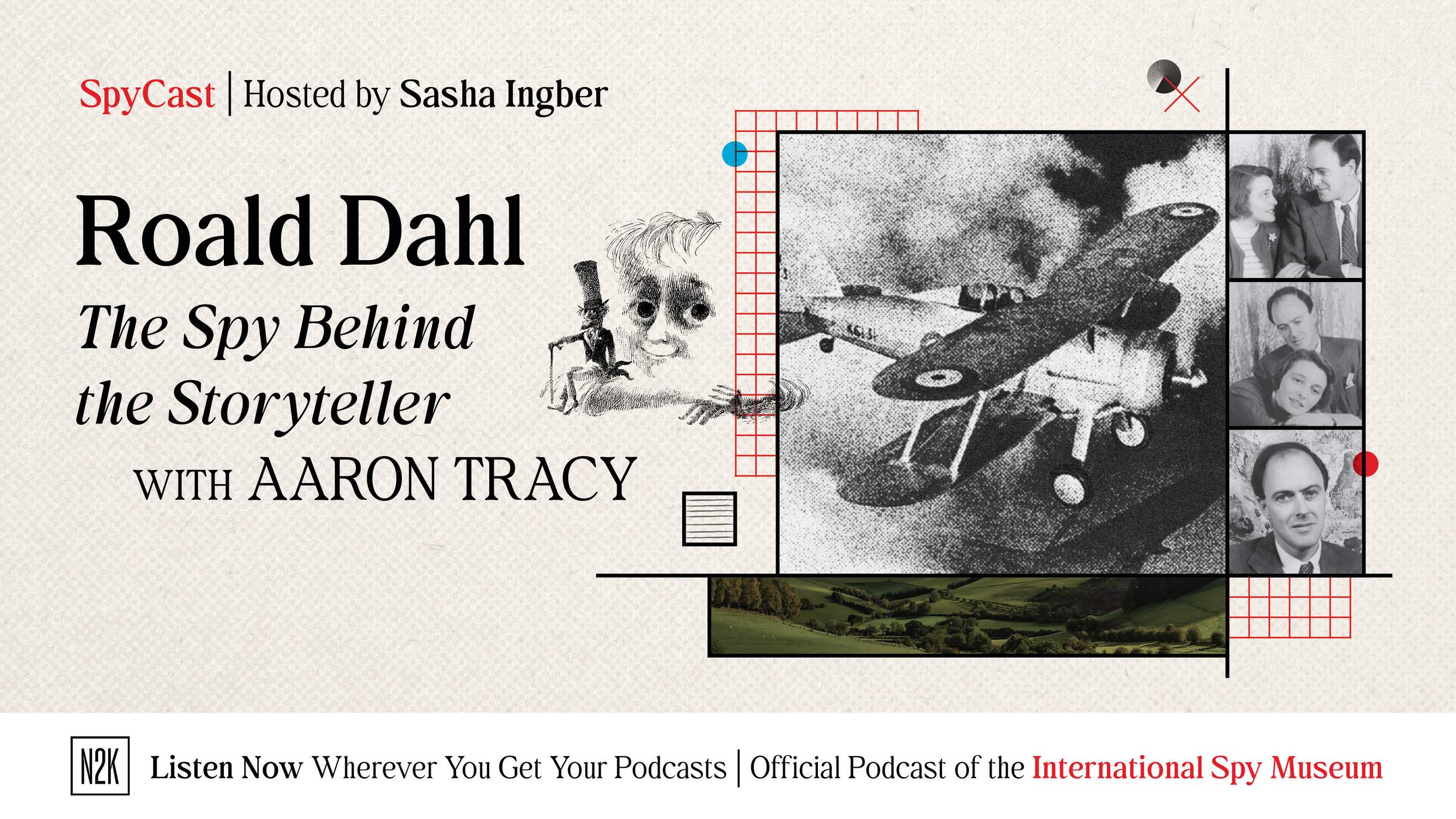


Roald Dahl: The Spy Behind the Storyteller










Sasha Ingber: Welcome to Spycast, the official podcast of the International Spy Museum. I'm your host, Sasha Ingber, and it's the first episode of Camouflage Month, highlighting our new camo exhibit, an exploration of the world of disguise, deception, distortion, and disappearance. And who better to represent deception than Roald Dahl.
Children grew up reading his tales of giant peaches and chocolate factories. Adults know of the controversy around his anti-Semitic remarks made in his later years, but before his life is one of the most successful children's authors of all time. Dahl worked for MI6, seducing Washington socialites and cozying up to the first family, all as a way to gather intelligence and exert influence for Winston Churchill In the early days of World War II, writer Aaron Tracy delves into Dahl's complicated life with a new podcast, the Secret World of Roald Dahl, out now.
Good morning, Aaron. Welcome to spycast.
Aaron Tracy: Hi. I'm so excited to be here.
Sasha Ingber: So Roald Dahl had been a businessman. Why was he drawn into service initially with the Royal Air Force during World War II?
Aaron Tracy: So he was a businessman. He was not just any businessman. He was a businessman for Shell Oil. Uh, it was like the AI of its time, uh, because so many, so many exciting things were using oil at the time, the aviation industry and the, you know, budding car industry.
And so he was in Africa, uh, working for Shell Oil and after a while, uh, he got a little bit bored of it. And overhead. He was seeing these planes fly, uh, as, as part of the war effort, of course. And he decided that that is what looked like the next big fun adventure for him. So he quit Shell and he found a car and he drove six hours, uh, to sign up for the Royal Air Force.
And he had never been inside a plane before. But Dahl was the kind of guy who was. Always looking for adventure. And so this just seemed like an incredibly fun adventure. And he was also very patriotic and wanted to help Britain in the war effort. And so he signed up.
Sasha Ingber: That's something, and he ended up being a pretty good pilot who saw crashes. He was in crashes. He survived a bad crash in a Libyan desert. Tell us more about what he saw and what he did?
Aaron Tracy: Yeah, I love the visual of it. First he was six foot six. Dahl was, and so he was flying in these open air hurricanes and Gloucester gladiators, and so his head was reaching way up above the windshield, so he was just being bombarded by, by wind and debris and, and insects, which is such a, a sort of a strange, funny visual.
But yeah, he was absolutely an ace. He was flying combat missions in, in Greece and, um, shooting down German and Italian aircraft in the, in the western desert. He almost didn't survive. Uh, as you said, he watched lots of other pilots in his battalion crash and die right in front of him, and he himself crashed all the time.
Uh, his worst crash was in the Libyan desert. Um, he had been given the wrong coordinates. By his commanding officer and he ran outta fuel in the darkness and he had to crash land in the middle of the desert. His face went forward into the console with such force that his nose went back into his skull.
His skull was fractured. He was temporarily blind. Actually, that temporary blindness lasted for weeks, but he dragged himself out of this horrific crash through the sand. The plane caught fire. Started firing off its ammo. The bullets barely missed all. He passed out unconscious in the desert. Uh, absolutely should have died that night, but spent months in the hospital after that.
That recovery in the hospital is a big part of where something shifted in him, where he sort of became an artist. And we see this with other great artists who spend long periods recovering. In a hospital, they have so much time to think and also to get used to really long stretches alone with their thoughts.
And so Dahl was, like I said, he was, he was basically blind and he was in the desert for months. Um, and he was basically, you know, becoming, uh, the artist that we would later know. And Dahl wanted to go back to flying. Uh, even after this horrible crash in the desert, but he kept having these terrible headaches from the injury and he kept passing out, which is of course not what you wanna hear if you are his superior, deciding whether to send him back up.
Uh, so they permanently grounded Dahl before he got too much of a chance, uh, you know, to do anything more. And, and that of course is when he moved on to espionage.
Sasha Ingber: That is when he moves onto the British Embassy in Washington, DC. As you say, first steps into the world of espionage, he catches the eye of Spy Master William Stephenson.
What does Stephenson see in Dahl?
Aaron Tracy: I think he saw what everybody, uh, saw in Dahl, which is this incredibly handsome 26-year-old, very tall, charming. Great storyteller with a fantastic fighter pilot backstory. So Dahl went to DC as, as you say, um, as an RAF attache, but he blended into Washington society very easily.
And so William Stephenson, also known as Intrepid, he was this just legendary, uh, person in, in the spy game. Uh, he, he saw in Dahl maybe a little bit of a younger version of himself. Um, Stevenson was also incredibly dashing and like Dahl, great storyteller and very enigmatic like Dahl. He sees a lot of potential in Dahl and so he has Dahl join his, uh, irregulars, this group of dashing young spies.
Um.
Sasha Ingber: And they were so dashing that they were tasked with seducing women. Dahl ticks off a list of extraordinarily wealthy high society women in DC. Before we talk about who some of these women were, can you share what the thought was? Why was MI6 so interested in going after the women?
Aaron Tracy: So a bunch of the women that he went after were incredibly powerful or influential in their own right.
Um, so in those cases it makes perfect sense to try to get them onto the British side. And you have to remember, this is before Pearl Harbor. This is before America entered the war. And so Britain is in its darkest hour and is doing anything that I can think of to try to get America to, to come into the war.
So, uh, recruiting influential people who might be able to advocate for America's entry makes sense. In some cases, it was because these women's husbands were actively advocating for America not to enter the war, and so the goal was either to find intel that they could use to blackmail. Some of these men, uh, or simply through their powers of persuasion to try to convince these women to convince their husbands that America needed to come in.
Sasha Ingber: Alright, so let's hear about some of Dahl's Conquests. Tell us about some of these women.
Aaron Tracy: Yeah, so the rumored list is very long and distinguished. People like Millicent Rogers, the standard oil ariss, Elizabeth Arden, who basically invented. American Cosmetics, Evelyn Walsh McLean, who owned the Hope Diamond, and through these legendary parties in DC and New York, uh, Beatrice Gould, who was the editor of the Ladies' Home Journal, but Dahls, his longest and most prominent seduction was with a woman named Clare Booth Luce, who isn't much remembered today, but she was incredibly influential and important.
Um, in her time. She was a Broadway playwright. She wrote The Women. Which was later adopted twice for the movies. She was a journalist. She was a very rare female congresswoman. Uh, she was 13 years older than Dahl, by the way, I should mention. And Claire was also married to Henry Luce, who ran Time Magazine and Life Magazine and Sports Illustrated, and was arguably the most powerful media figure in America.
Um, and his magazines, uh, were often publishing anti-British pieces. And so this was something that, that Churchill and Stephenson and the Irregulars could not have. So Dahl went after Clare. He actually met her one night when he was out at a film premiere with an Oscar winning actress who was 12 years older than him.
Dahl liked older women, uh, Nancy Carroll, and he did not go home with Nancy that night. And so there's, there's a lot of great stories. Uh, about his relationship with Clare, um, that I could tell you about, but it's just, it's sort of extraordinary how successful Dahl was, uh, with all of these women.
Sasha Ingber: Feel free to give us a story.
Aaron Tracy: Yeah. Well, Clare was a lot, let's put it that way. Um, Dahl says that during their affair, he had to go to the British ambassador because. He just couldn't handle Clare anymore. He said that she was absolutely insatiable for him.
Sasha Ingber: That's an interesting HR conversation, right?
Aaron Tracy: I'm doing my best. I'm not sure how young your, uh, your youngest podcast listeners are.
Sasha Ingber: The stories go on, but let's also think about the US intelligence community right now. FBI is being led by J Edgar Hoover. He has to know what's going on here. What is he saying? I mean, how does he feel about the fact that these British spies are just running around DC and other cities seducing women, trying to change public opinion to get the United States to join the British War effort against the Nazis?
Aaron Tracy: Yeah. Uh, Hoover was furious. Uh, he saw it as a direct incursion onto his turf. No question. And you gotta remember where Hoover is at this point. I mean, he'd been running the FBI since 1924, so nearly two decades in. He's probably the most feared man in Washington. Politicians are terrified of him. And here's this group of incredibly handsome young foreign intelligence, uh, service officers just running around answerable to, to no one in America. And Roosevelt seems to be looking the other way. So Hoover is able through, you know, connections in Congress to make it so that the BSC, uh, the British Security Council and the Irregulars, um, have to run everything from now on through the FBI. Now Williams Stephenson had absolutely no intention of doing that.
He was not gonna run all of his activities by Hoover. So there's this fun story where London sends over an agent specifically to watch Stephenson and to make sure that he complies with this new order of, of running everything through Hoover. Essentially, they send over a reminder. Stephenson, of course, immediately knows what's happening.
And turns to young Dahl for help. I mean, he's, he's perfectly suited for this. He's, he loves coming up with sort of creative solutions. So Dahl invites this minder, this, this agent over to his apartment and he gets him drunk and he keeps him talking. Uh, and somewhere in the apartment, Dahl has hidden a tape recorder.
And so this agent, feeling, you know, loosened up, starts feeling comfortable and starts saying terrible things about his bosses in British intelligence. And Dahl gets it all on tape and he hands the tape to Stephenson who sends it back to London. And this agent, this minor, is recalled immediately. So the threat is neutralized.
Dahl later takes this exact operation, uh, the idea of, of hiding a tape recorder in an apartment so that an unsuspecting guest will say things, uh, that he shouldn't, and he puts it into one of his short stories. Um, Dahl was always, always watching, always collecting for his later writing.
Sasha Ingber: Well, that man really hadn't done his homework on how to be a Spy Dahl's social skills took him incredibly far. He ultimately even socialized with FDR, who you had mentioned. How does a young spy befriend an American president in Washington?
Aaron Tracy: I dunno. It's, it's amazing, isn't it? I mean, if for a 26-year-old spy, if he had just made friends with like an intern, like that would be huge in the White House.
Sasha Ingber: An intern would be a total coup.
Aaron Tracey: Completely.
Sasha Ingber: This completely is next level.
Aaron Tracy: Right? But, and you know, this is kind of how Dahl's Life works, and I talk about this throughout my podcast, that he would live this sort of Forest Gump like existence where he just keeps meeting. The most powerful people, the most interesting people in whatever city he's in, and completely charming them and is just sort of present for all these really important historical events.
So in this case, he befriends the first family. So specifically Dahl wrote a short story called The Gremlins, uh, which is about RAF Pilots and these mischievous little creatures who are sabotaging their planes. It's a propaganda piece about British and American cooperation, and it gets published in a small, local Washington DC magazine, and Eleanor Roosevelt got her hands on it and she loved Dahl's story so much she started reading it to her grandkids. And she invited the author over to the White House. And so here's Dahl again in his mid twenties going over to the White House. And he's charming and he's funny, and he's handsome, and he’s got the war hero thing. And the Roosevelts take to him completely. Uh, they invite him up to their weekend retreat in Hyde Park over July 4th weekend.
Um, and it, it's just kinda amazing. Uh, FDR completely takes to him. FDR takes rolled out on, um, on drives in this, in this kind of rigged car that FDR has had built. He takes Dahl driving around the estate. He has Dahl mixed martinis with him, and they're just like. Talking freely. It's, it's what you do with someone you, you like and trust.
Sasha Ingber: Did the Roosevelts have any inkling that this British diplomat was a spy? These are people who you'd think have awareness of, you know, reality and the, and the threats, yeah. Of, of being a spy. It's quite natural that many diplomats are actually just spies under diplomatic cover.
Aaron Tracy: Totally. I, I think we should probably give Roosevelt the benefit of the doubt that he probably knew or had an inkling, um, and either didn't care or possibly, and we don't know of course, but possibly was using Dahl for his own ends.
Um, Dahl. For instance, left that weekend in Hyde Park and wrote up a 12 page report, uh, that he sent back to London about what was actually going on, he believes, in Roosevelt's mind. And so this might have been a way for FDR to get, you know, that kind of intel to Churchill, uh, without all of the sort of diplomatic hassle.
This might have been a back door for FDR because what everybody wants to know, what Churchill was dying to know was, is FDR gonna get America into the war and when and on what terms?
Sasha Ingber: And was Dahl providing information that was useful to Churchill in assessing whether FDR had the appetite to get involved in the war?
Aaron Tracy: So in the end, we don't know how successful, um, Dahl was in, in sort of, um, uh, you know, calling. FDR's mood. Uh, but there's every reason to believe that it helped, uh, Churchill sort of become more acquainted with what was going on in FDR's mind.
Sasha Ingber: You also told me that Dahl ultimately did come clean about his spying to a newspaper magnate Charles Marsh.
Can you explain why he did that, and then how Marsh responded?
Aaron Tracy: Yeah, so one of the most important relationships in Dahl's Washington years was, was with this man, Charles Marsh. Marsh was kind of an extraordinary figure of his time. He was a, a Texas newspaper magnet, um, just incredibly wealthy and really, really well connected.
He, he liked to hold court. In his mansion on our street in Georgetown. Politicians and journalists and power brokers were just constantly going in and out. Um, marsh took to Dahl, took him on as a, as a protege, and so was constantly inviting him into the house. There were often poker games, and so Dahl would be, would be sitting at marshes playing poker, uh, with other, you know, Washington power brokers, and on one particular night, Dahl was going all in and Dahl was not making much money as part of the Irregulars back then. And so he, he had his full, I think it was like two weeks of his pay. Uh. A hand and he lost it, which was a bit of a, an earthquake for Dahl, but the person he lost it to was Harry Truman.
And so the connections that Dahl is making are just invaluable.
Sasha Ingber: Unreal, unreal. I mean, could it happen today?
Aaron Tracy: Doubtful. Uh, it feels very much like a different time.
Sasha Ingber: Why did Dahl decide that he was going to reveal this incredibly important piece of information about himself that would make him so much more vulnerable in Washington?
Aaron Tracy: Yeah. Yeah. And so Marsh really just thought Dahl was, uh, was an at attache working at the, at the British Embassy. Um, but I think that Dahl saw that. Marsh could be a potential ally. Um, and so it, it was a risk. I mean, it could have turned out very badly for Dahl, but at some point Dahl decided to, to reveal himself to both, uh, marsh and to Marsh's daughter, uh, who was his good friend.
And Marsh was tickled. Marsh loved the fact that, uh, he had this spy in his midst that, uh, you know, they had the same, they had the same goal. They both wanted to get America into the war. And so Marsh became even more of a mentor to Dahl and started teaching him his old newspaper tricks about how to ask the right questions in the right way in order to get good intel.
And Marsh also started introducing him to even more people. That could be helpful for him in the espionage game. So it, it turned out to be incredibly helpful, uh, for Dahl now to have this ally who knew exactly who he was.
Sasha Ingber: A rather unusual reaction by an owner of a journalistic empire. Um. Would that happen today is a question that I have been thinking over and over again as we've talked.
So eventually Dahl has seduced so many women that he's almost kind of run out as far as I've understood it from your work, and now he goes to New York and the British spies are operating out of Rockefeller's Center, so he joins the mix. Tell us about some of the adventures he gets into in New York.
Aaron Tracy: Yeah, I mean, first. It's nuts to me that they're working out of 30 Rock. When I think of 30 Rock, I think of, you know, it's where SNL is, is filmed. It's not where you would expect the headquarters of this very secretive spying to be.
Sasha Ingber: Right. I know. It's like, well maybe the MI6 is operating out of a Walmart in Virginia right now.
I, I may not. Who knows.
Aaron Tracy: So Dahl loves it for Dahl, this is like Xanadu. I mean, this is a guy who loves to, to meet women and to party and to just, you know, sort of drink into the late hours. And so New York, you know, in the 1940s, this is the 21 club and this is El Morocco and this is this Store Club. And Dahl's completely taking advantage of all of it.
Um, and we haven't really talked about who else was in the Irregulars. You know, Stephenson had an incredible eye for talent, and so it's, you know, role Dahl is there, of course, but also David Ogilvy, who would go on to basically invent modern advertising and become the inspiration for Don Draper on Mad Men.
Uh, Noël Coward, one of the most celebrated playwrights ever, Ian Fleming, who would go on to create James Bond. So the way I sort of think about it is. Roald Dahl, James Bond, Don Draper and Noël Coward. Just kinda at, at 26 years old, just like running around New York City in the 1940s, just playing spy games and having fun.
It's, it's just incredible to think about
Sasha Ingber: When we come back. Aaron describes the end of Dahl's spying and the start of his literary success and family tragedy.
How did Dahl’s spy career end?
Aaron Tracy: Um, so when the war ends, uh, the BSC, the, the irregulars, uh, basically they don't have much left for Dahl to do. Um, and so he does, he does, I don't know what, what you do when the adventure is over, you go back home. Um, he had not been back in Buckingham. Sure. Uh, for years. He hadn't seen his mother and sisters for years.
Uh, so that's what he did. He went home, he moved into his mother's basement. He started tending to her farm. He started gambling. He started drinking. He started dog racing. It really feels to me like he kind of lost his purpose and, and I can kind of feel that trajectory. He's in his late twenties, early thirties.
He's had this extraordinary run as a, as a fighter pilot and a Washington Insider and, and on the, the New York social scene and drinking martinis with FDR and, and now he's just kind of, you know, like floundering.
Sasha Ingber: I mean sleeping in your mom's basement after drinking and going out on picnics with FDR.
Imagine that's a tough transition.
Aaron Tracy: Yeah. So I mean, we all know people like this, maybe not to this degree, but people who burned very bright in their twenties and thirties and then, and then came home to spend the rest of their life telling people about how exciting it used to be. And that very much might have been Dahl, except for Charles Marsh, right?
His great mentor, the, the newspaper magnet Marsh sees what's happening to his protege. And he absolutely refuses to accept it. So he sends for Dahl, literally marsh flies Dahl back to New York, installs Dahl in his empty apartment and pays his way. Covers all of his expenses, no strings attached, um, until Dahl can make it as a writer, which is just like an incredibly generous thing to do.
I, it's so hard for me to imagine someone doing that today. Marsh also introduces Dahl to Harold Ross, the founding editor of The New Yorker, which of course, in the 1940s is just as it is today, just the pinnacle of American short fiction. Um, and so that is what began, uh, Dahl's writing career in earnest.
Sasha Ingber: So Dahl's friendship with Marsh is incredibly important in starting his real writing career, even though he's been writing before. This is the turning point. How is intelligence showing up in his writing at this point, based on these experience that he's now carrying with him?
Aaron Tracy: Yeah. Yeah. It's, you know, I, I think if, if you know what to look for, then the spy years are kind of everywhere in Dahl's fiction.
You can see it in Willy Wonka. Certainly. I don't think people necessarily think of Willy Wonka as a spy figure, but, you know, he's, he's very much based on William Stephenson, um, this sort of small, quiet, unassuming man running this massive covert operation. Very enigmatic, very brilliant. Uh, very clever.
That's almost no one into his inner world. At 30 Rock, there was an incredible elevator in this art deco building. Charlie and the Great Glass Elevator, uh, the elevator is based on, uh, that elevator at 30 Rock, but then of course the, the clearest expression of of Dahl’s spy work finding, uh, a way into his fiction is with James Bond.
Um, Dahl gets hired to write, “You Only Live Twice.” Uh, the fifth James Bond movie, which by the way is a huge gamble by the producers because the same person had written the first four bond films. Um, but they wanted Dahl. He knew Ian Fleming, the originator of James Bond, and, um, Dahl had been a spy himself and sort of could, you know, have his own experiences and form the work.
And that's exactly what happened. Um, in Dahls screenplay. You just see over and over again Dahl bringing his own experiences into the movie.
Sasha Ingber: So why did he move away from writing for adults into writing for children?
Aaron Tracy: Yeah, I am. I am struck by the irony that, um, his biggest success, you know, writing for kids is what first opened the door, uh, to him in his spy world of, um, you know, got him into the White House.
He wrote that, that story, the Gremlins, which Eleanor Roosevelt loved and invited him to the White House and to Hyde Park. So it's as if it was just sitting there the whole time. This idea that he could be a huge success writing for kids, but he just didn't want to. He saw it as beneath him. Then there were a series of tragedies with his family, uh, that sort of refocused his attention on his kids.
And that's sort of what led to, uh, him, him devoting himself to, to write children's stories. His son, Theo, was just three months old and was hit by a taxi in New York. Um, got brain damage and spent months and then years, uh, in and out of a hospital
Sasha Ingber: And on his son, at one point, Dahl even turned to a toy maker to innovate a device that would help his son's brain, which ended up saving the lives of thousands of children.
Aaron Tracy: Yes. This is one of my favorite things about Dahl. One of the things I discovered while making this podcast that I absolutely, it, it made me fall in love with Dahl. It's just so heroic and so romantic. His son, um, had hydrocephalus from being hit by the taxi and all the subsequent surgeries, and there was no medical tube in existence that could help get the water off of his son's brain without causing infection.
And so Dahl, who I mentioned, I mean, he had this like Forest Gump like existence where he just triumphed and triumphed and triumphed again. And so he had the confidence to say, you know what, no doctors have figured this out how to build this medical tube. I think I'll give it a shot. So what he did was this very creative thing.
He got together, um, this neuroscientist that he knew, uh, Till, and he got together, uh, with this toy maker, Stanley Wade, and the three of them. Just sort of had their own, what I think of as a little writer's room, throwing ideas at the board, uh, about how to create this tube and were successful. I mean, they made these small changes, but they were enough to fix the problem so that water could be removed from the brain without causing infection and Dahl insisted that they make no money off of this because he wanted it to be distributed widely and it ended up being distributed widely. And yes, it's credited with being used in over 3000 kids. It's called the Wade-Dahl-Till Valve.
Sasha Ingber: But in the midst of, of this innovation, more tragedy occurred and if you want to continue on with all of the family strife.
Aaron Tracy: Yeah. Yeah, just awful. His, his daughter Olivia, was seven. Uh, when she contracted measles, they weren't able to give her the measles inoculation because there were so little in England where they were living at the time, and they needed to inoculate Theo. Because he was so fragile from being hit by the taxi.
Sasha Ingber: They didn't think that she was going to get sick and catch encephalitis, which would then lead to the brain inflammation that this medication could have prevented.
Aaron Tracy: Exactly. Yeah. And so Olivia died at seven, which was the same age that Dahl's sister died. When he was a kid. And so just this, this horrible mirror. Um, and then as if all of that wasn't enough, his wife, Patricia Neal, who is just this extraordinary woman, this Oscar winning actress, incredibly beautiful. Um.
She was 39 years old at the height of her career, and she had a series of strokes, uh, massive strokes. And the doctors told Dahl that she would absolutely not recover. Um, Dahl did not listen to that. Uh, Dahl had his own ideas and he put her through this sort of militaristic regime of, uh, rehabilitation and it was grueling and it absolutely pushed Dahl away from his wife. Um, she hated him for it, but she also got better. Um, which is just extraordinary. She almost made a full recovery, which nobody was predicting. None of her doctors predicted. But for this long period, through all of these tragedies, practically, because his wife was not able to, to earn money anymore, Dahl needed to find a way to really earn money.
And his brain was on his kids. He was just constantly thinking about his family. And that's when he finally turned, uh, to kids' books and he wrote his first, uh, James and the Giant Peach.
Sasha Ingber: There's so much tragedy, and yet there's also some resilience here. And yet it seems like he was quite haunted.
Aaron Tracy: Oh, yes.
Yeah. I mean, I can't imagine. Um, it's just awful.
Sasha Ingber: So all of the success that he experiences and he and his wife do go on to divorce. He has an affair with a woman who had worked, um, on set for a movie that she was in. Um, he still has a lot of a bumps in the road. Fast forward to him being an old man now, and he ends up taking on the same mentality as the Nazis that he fought in the Royal Air Force.
He says, quote, there's a trait in the Jewish character that does provoke animosity and quote, even a stinker like Hitler just didn't pick on them for no reason. So how does this happen to a man who starts out with this noble mission to now become a blatant antisemite.
Aaron Tracy: I think that he felt a profound sense of betrayal.
He felt like he risked his life. He lost a lot of friends in the war, in part of course, trying to save the Jewish people who were being exterminated. Um, and now decades and decades later, he saw. Israel, um, inflicting suffering on others, but he makes this this horrible leap, which we see a lot today.
Instead of directing his anger at the Israeli government over their specific actions, and specifically what he was, um, angry with was the Israel, the Israeli invasion of Lebanon. Um, so instead of, instead of pointing his anger at Israeli leadership, um, he blamed all Jewish people everywhere, which again, we see a lot today.
Um, so of course, yeah, he crosses a line where there's just no justification.
Sasha Ingber: Does the last chapter of his life in this intolerance of a people, does it detract from the work he did for his country as, um, intelligence officer? How do you reconcile those two elements of his life?
Aaron Tracy: I mean, it absolutely colors his legacy.
Um, I hope that it's not the very first thing that people think of when they think of Dahl, although I'm sure it is for many people. Um, I don't think it erases. All the good he did the coming up with that tube to save his son Theo's life and to save thousands of children around the world, and all the pleasure that he's brought to millions of people, hundreds of millions of people through his work.
But no, you unquestionably have to grapple with it. And I think that's part of what makes Dahl such an interesting subject for my podcast, that he's not just one thing.
Sasha Ingber: As a last question. When you describe the complexities of this person and the complications of his life, there is a fear of doing it justice.
Do you feel like you've done Dahl justice?
Aaron Tracy: I don't know. I mean, I think that'll be a, a question for listeners. I hope so. I certainly hope so. The podcast consists of six episodes of narration and clips of interviews with Dahl. And then the next few episodes I open it up to interviews and I talk to cultural critics and even someone who knew Dahl, um, in real life.
And we're trying to get a full picture of the man. Um, and so I hope people will walk away from the podcast feeling like they know him a lot better, that he was not one thing, that he was incredibly complicated and, and yeah, just, just feel like it was not a one-sided piece, but that they get a full picture of an incredibly complicated man.
Sasha Ingber: Aaron, really appreciate this conversation with you and fascinating, fascinating work.
Aaron Tracy: Well, thank you so much. I, I absolutely love your podcast. I'm, I'm thrilled to be on it. Yeah. Uh, I'm excited for your listeners to, to check out my show. The Secret World of World Dahl.
Sasha Ingber: Secret World of World Dahl, and I'm excited to have you back.
Aaron Tracy: Thank you anytime.
Sasha Ingber: Thanks for listening to this episode of spycast. If you like the episode, give us a follow on Apple, Spotify, or wherever you get your podcasts and leave us a rating or review. It really helps. If you have any feedback. Or you wanna hear about a particular topic, you can reach us by email at spycast@spymuseum.org.
I'm your host, Sasha Ingber, and the show is brought to you by N2K Networks, goat Rodeo, and the International Spy Museum in Washington, DC.