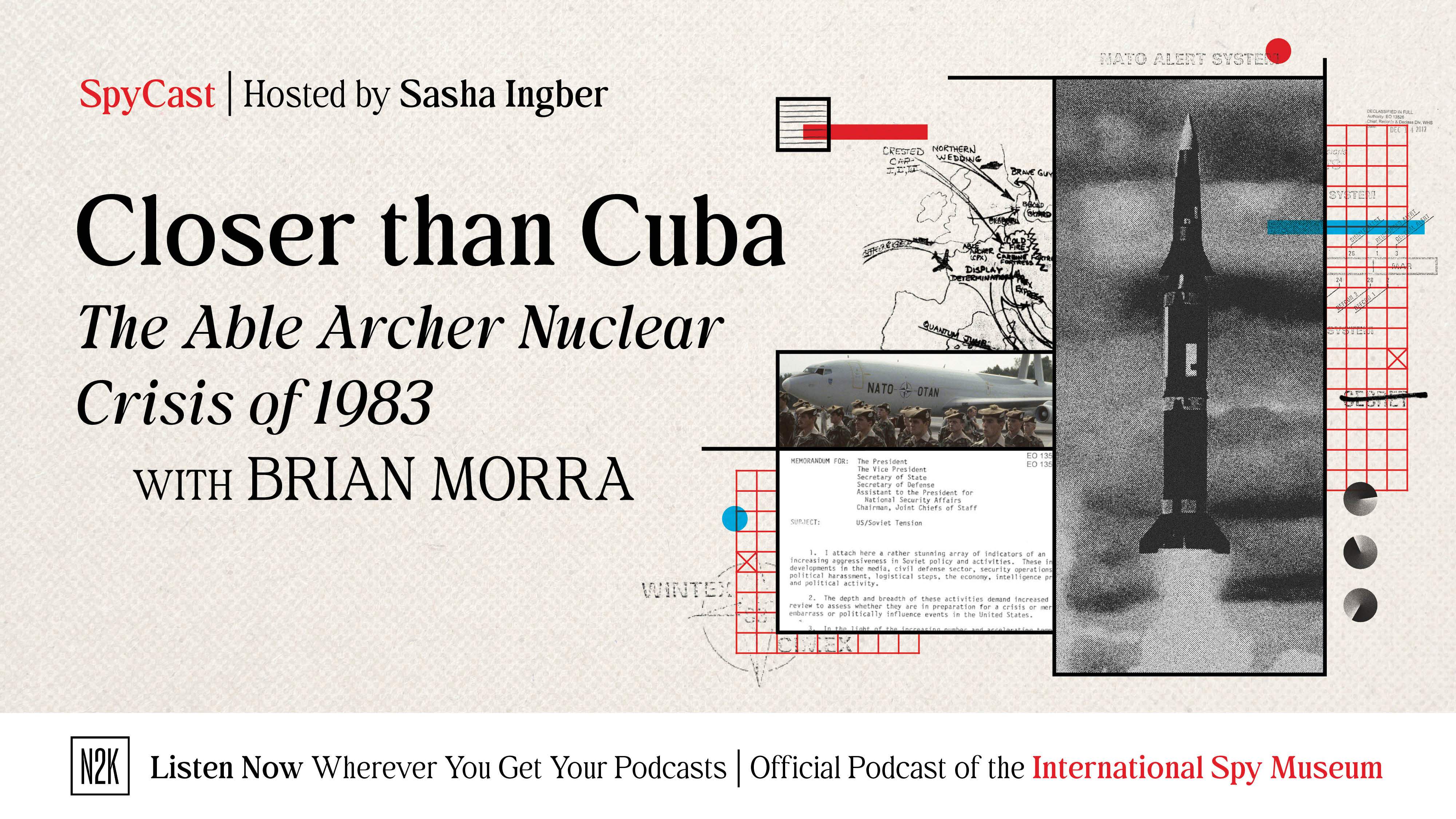


Closer than Cuba: the Able Archer Nuclear Crisis of 1983










Mark Jacobson: Welcome to SpyCast, the official podcast of the International Spy Museum. I'm Dr. Mark Jacobson, filling in for Sasha Ingber today. We're stepping into the hidden world of spies shaping events around the world.
It's November of 1983, the closest the world came to nuclear war, even closer than the Cuban Missile Crisis of 1962, and yet the Able Archer 1983 exercise incident is relatively unknown by comparison.
A series of events starting with the Soviet shootdown of a Korean Airlines plane ended with not one, but two almosts, when it came to accidental nuclear war, including a simulated nuclear release authority request that may have been seen in Moscow as the prelude to a first strike. How these events unfurled was a result of heightened Cold War tension, antagonism, and miscommunication.
Brian Morra was a US Air Force intelligence officer who had a front row seat to this and sits down with me today to discuss how the world came to the brink of nuclear war.
Brian, it's great to have you with us today.
Brian Morra: Well, thank you very much, Mark. Really appreciate the opportunity to speak with you, and I'm a huge fan of the International Spy Museum and everything you all do, so it's a great pleasure.
Mark Jacobson: So let me take you back to 1983. The second Cold War has begun. Uh, in the summer, the movie "WarGames" came out, putting global thermonuclear war into the public consciousness. Tensions are heightened. Was this just another Cold War downturn, or was there something qualitatively different about 1983?
Brian Morra: So I think there were a number of factors that contributed to making 1983 qualitatively different.
Um, and one was that detente had effectively ended. Ronald Reagan was president of the United States and was seen as the great anti-Soviet and anti-communist warrior. There was a leadership in the Kremlin that was peculiarly, uh, paranoid about the West, and especially about Ronald Reagan's United States.
So I think all of those factors and others contributed to making it qualitatively different.
Mark Jacobson: So clearly the, the atmosphere is tense, but I, I want to talk about something specific, something the Soviets do in light of this tension, and this is Operation RYAN. And I'm not going to say it in Russian, but the English translation is basically nuclear missile attack.
So it's, it's not, it's not a subtly named operation.
Brian Morra: Right. Yes. Operation RYAN or REE-AN as, as the Russians would pronounce it, uh, was the largest Soviet intelligence collection effort after World War II. So that gives you a sense of its scale. And essentially, Operation RYAN or REE-AN, uh, began with a premise, and the premise was: we know the West is gonna launch a nuclear first strike against the Soviet Union. We just don't know when and where. So, uh, the KGB and Soviet military intelligence officers at GRU were tasked globally with finding indications that the West was preparing for a nuclear first strike.
Mark Jacobson: So you already have the conclusion, and Ryan, the project, the analysts, the assessments are simply looking for the evidence that justifies this, uh, preordained conclusion that there will be nuclear war.
Brian Morra: Yes. And, and the leadership in the Kremlin, many of them in 1983 were veterans of World War II, and their great nightmare was another surprise attack similar to that of Nazi Germany, which was called Operation Barbarossa in 1941 when they invaded Eastern Europe and the Soviet Union. And I think that is another factor in their paranoia and really underscored the importance that they held for, um, Operation RYAN, that it was an important intelligence collection effort.
Mark Jacobson: Brian, so given this predisposition and this concern about a surprise attack, how is that shaping potential Soviet operational responses to even routine US activity when it comes to, uh, potential first strikes or exercises simulating first strikes?
Brian Morra: Yes. Well, they certainly were on a heightened alert, so to speak, particularly after Ronald Reagan came into office in January of 1981.
And so in both in 1982 and in 1983, the United States conducted major exercises, especially naval exercises, both in the Atlantic in '82 and the Pacific in '83, that were extremely provocative and not routine. And those exercises and their provocative nature fueled the fire of paranoia in the Kremlin. And so the, the Soviets didn't have to look too far afield to see, hey, these Americans are doing things that are very, very provocative, including, in the case of the Pacific Fleet exercise, violating Soviet airspace.
So their paranoia was perhaps not completely just in their minds.
Mark Jacobson: So, so despite a stated no first use policy on nuclear weapons, there's real concern that under certain circumstances, the United States might choose to go nuclear first.
Brian Morra: Well, actually, I, I, I think that's a point that bears examination because the United States actually has never had a no first use policy.
So the United States has explicitly been ambiguous about that, if one can be explicitly ambiguous. But the, uh, so the United States does not have a no first use policy, and the Soviets were very aware of that. So the US had the means, and maybe they have the desire. So I think all of that fueled their, again, their fear.
Mark Jacobson: So as we get into the autumn of 1983, we have not just a, a, some ambiguity in terms of whether or not the US would use nuclear weapons first. We have the increased tensions both at the presidential level in terms of the rhetoric of the Evil Empire, but we also come into a series of incidents that, that really ratchets things up.
It really brings things into perspective, and, and the first is the shoot down of Korean Airlines 007, KAL 007. You were on duty for that. Can you tell us what it was like to be, to be in the front row for that, and tell us a little bit about what you thought was happening initially?
Brian Morra: Yes, I just happened to be on duty that night.
I was an Air Force intelligence officer in Tokyo, Japan. So that night, um, we were not certain, as one often is not in intelligence, current intelligence situations, we weren't certain what was happening. We just knew there was very, very unusual Soviet activity, air defense activity that was initiated over the Kamchatka Peninsula and then continued during the night over Sakhalin Island.
And we tried to eliminate every possibility. Uh, was this a Soviet exercise? If it was not an exercise, then what aircraft are they searching for? Because they were clearly looking for something. Was it a US Air Force intelligence collection flight? There had been a US intelligence collection flight off the coast of Kamchatka, uh, during that night, and in fact, I learned quickly that it had, had already departed the Kamchatka area and was heading back to Alaska to its base in the Aleutian Islands.
So again, the question was, well, if it's not that flight that they're looking for, what are they looking for? So we, we contacted, uh, the equivalent of the FAA in Tokyo and asked if they had any transpacific airliners that might be off course, and they reported to us, "No, everybody's reporting in. Uh, there's no problem. No one's off course." In those days, it's almost hard to imagine a world in which an airplane which took off from Anchorage, Alaska, as this one did, KL007, which we later learned was the, the mystery airplane. Once it cleared Alaskan airspace, there was no positive control. There was no radar coverage to give positive control.
There was no civilian GPS in those days. So once an airplane left Alaskan airspace, it was really on its own until it entered Japanese airspace on the other side of the Pacific. So an airplane could disappear, if you will, and, and that's what happened to KL007 that night. We later learned that the reason it disappeared was that, um, its crew had put in the wrong coordinates into its navigation system after they left Alaska, after they left Anchorage, and that the, the erroneous coordinates in their nav system had them flying a couple of hundred miles north of where they were supposed to be, and consequently, they overflew very sensitive Soviet military and naval facilities by mistake.
And that they paid for it with their lives ultimately.
Mark Jacobson: And is there a point where the Soviets understand or are having uncertainty about whether or not the aircraft they're tracking is a civilian airliner rather than a US intelligence flight?
Brian Morra: Yes, a very important question. They were very, very confused.
They, I think, held to the belief that the, it, the airplane they were looking for was probably a US Air Force intelligence collection aircraft. I think they couldn't imagine that a civilian airliner could have gone off course that badly. But it's also important to note that in the 1983 US Pacific Fleet exercise, which occurred in late March and early April of 1983, uh, US naval fighters overflew Soviet airspace, which was, uh, and they were never intercepted.
Mark Jacobson: Deliberately.
Brian Morra: Apparently, yes. And, and, and they were never intercepted by Soviet fighters. And because of that, the Soviet air defense system throughout the Far East was on an unprecedented state of alert from April through the 1st of September, uh, 1983. The 1st of September was the, the day the Korean airliner was shot down.
So there was no officer in that Soviet air defense network wanted to be the guy that did not intercept another border intruder, as they, they called planes that would stray into their airspace, whether intentionally or not. And so there was a high motivation on the part of these Soviet air defense officers not to let whatever this mystery plane was, not to let it leave their airspace unscathed.
And I, I think that once they saw the plane cross over Sakhalin Island, uh, they became panicky that it might leave their airspace and head south and they, without them intercepting it. So once it got close to Sakhalin Island, the Soviet air defense forces sent up a number of fighters to try to intercept, identify the airplane, and try to force it down, and failing that, their orders were to shoot it down.
Mark Jacobson: So Brian, we have a situation where there's some provocative incidents, there's a predisposition on the Soviet side for action, but one of the striking things in your account is that there is almost an air-to-air engagement between US and Soviet forces following the shootdown of KLL007.
Brian Morra: Yes, and my book, "The Able Archers," is the, I believe the only thing that's ever been published about that account and about that incident.
But yes, Mark, you're absolutely right. So in, uh, in the 48 hours or so after the Korean airline shootdown, the crash area, which was off the coast of Sakhalin Island, the spot where the plane went into the sea, became very heavily congested airspace and sea space, very congested and contested. And at one point during that, that tense period in the hours and immediate days after the KAL shootdown, the Soviet air defense forces ordered two MiG-23 fighters to shoot down a US Navy intelligence collection plane with about two dozen Navy personnel on board, and that plane barely It was able to get away from the, these Soviet fighters, and while it was attempting to evade the Soviet fighters, the commander I worked for in Tokyo ordered four US F-15 fighters to intercept those MiG-23s and shoot them down if necessary.
But he was very specific in his orders, which was, "You will not fire unless you get a specific order from me to do so." And as it happened, they did intercept the MiG-23s, the F-15s did. The Navy plane was able to escape, uh, successfully, although not without many injuries to people on board the plane, because their only evasive maneuver was to dive for the wave tops from about 25,000 feet.
So lots of people were, were pretty badly injured on that plane. In any event, they got away safely, and, and the commander of US Forces Japan, who was, uh, General Charles Donnelly, called the F-15s back and, uh, and had them return to their combat air patrol position. And we came within seconds of air-to-air combat, but fortunately, we pulled back from the brink.
Mark Jacobson: Another incident at the tail end of September 1983, and I think for our listeners, uh, we may best call this the Petrov Incident. And could you tell us a little bit about who Colonel Petrov was, why he was important, and how this plays into what's going to happen in November with Able Archer?
Brian Morra: Yeah. So Lieutenant Colonel Stanislav Petrov was a career Soviet air defense officer.
He was a graduate of the very prestigious Air Force Academy in Kyiv. Interestingly, it was in Kyiv, Ukraine. And, uh, he was a scientist. He was trained as an electrical engineer and physicist, and his job at the National... the Soviet National Missile Defense Center was to write algorithms and to do signal processing on the signals from Soviet missile warning satellites.
But on the night of the Petrov Incident, as it's become known, the 25th and 26th of September 1983, Petrov was called in to the National Missile Defense Watch Center to be the watch commander for that night because the guy that was supposed to do that job was sick. So Petrov was called in at the last minute, and, uh, shortly after midnight, the missile warning satellites gave warning of several intercontinental ballistic missile launches coming out of Grand Forks Air Force Base in the United States toward the Soviet Union.
And that kicked off what is known as the Petrov incident again for the next 30 minutes or so. There were successive waves, not massive waves, small waves of two, three, four, five intercontinental ballistic missile launches heading towards the Soviet Union. So Petrov, for 30 minutes, had to make a determination, are these real launches?
Are they erroneous reports what we in the business call false alarms, from these missile warning satellites? And remember, he's the expert on the signals and processing the signals from those satellites. So he determines that contextually it doesn't make a lot of sense. If the United States is gonna launch a nuclear first strike, they're not gonna just launch two Zs, three Zs, four Zs of missiles.
They're gonna launch hundreds of them. And, and he detected that maybe there's some anomalies in the signal coming from the satellites. He, he had no time to really figure out what was going on with the satellites, but he knew enough about them that he made the determination, I don't think this is a real thing, and he delayed reporting it up his chain of command.
Uh, he was-- he later said he was worried what his chain of command might do, that they might... Because the Soviets had a policy, they had a policy of launch on warning. So if they had warning of a first strike, their policy was, we're gonna launch a retaliatory strike immediately. He himself later said he had trepidation about how the leadership in Moscow might react, particularly given the incredibly tense situation with the United States after the Korean airline shoot-down, which had just been a few weeks earlier.
He knew that the Kremlin was paranoid about a nuclear first strike from the United States, so he took his time in reporting until he had really good assurance from the rest of the warning system in Soviet Union that these were probably false alarms. And it was only then that he reported up his chain of command that, um, this incident had occurred.
He was initially lauded for his prudence, but then once it was determined that these missile warning satellites had operated erroneously, which was in fact what they had done, this incident embarrassed some very powerful people, and Petrov's career was, was effectively destroyed over this incident, and he had-- he was forced to retire as lieutenant colonel.
Mark Jacobson: But a hero, the man who saved the world from nuclear war, yes?
Brian Morra: Yes, and he, he later became known, um, as the man who saved the world, but he was not lauded for that within the Soviet Union. He was, he was-- He retired in disgrace, uh, which is a very sad story of the rest of his life. And it was only late in life that, uh, Europeans in particular and the United Nations acknowledged the incredibly important role he played that night in preventing a general nuclear war.
Mark Jacobson: When we come back, we talk about how once again, individuals mattered.
So let's get to Able Archer. It's autumn of 1983. You have, uh, the larger Autumn Forge exercise series, the, the chapeau, if you will, for Reforger, which will be the, uh, the exercise that's going to test the ability of, of the United States to, to help, uh, resupply NATO in the event of a war with the Soviet Union.
And then you have Able Archer, the command post exercise, the nuclear component that we'll, we'll speak about. So what is it that these exercises, these are supposed to accomplish for NATO?
Brian Morra: Well, those, the Autumn Forge series of interconnected exercises were, as you said, to really test the ability of the NATO forces to deal with a, an invasion by the Soviet forces into, uh, the eastern part of NATO.
And these exercises went up the escalatory ladder, if you will. And what I mean by that is the initial phase of the Autumn Forge ex- exercises was a conventional war phase. The second phase typically would be a chemical war phase, and then the third and final phase was a nuclear war phase. Sometimes that varied a little bit, but that was essentially the scenario in the fall of 1983.
And Able Archer was the name given to the nuclear war phase of the exercise. And as you said, it was largely a command post exercise. But in 1983, it was not exclusively a command post exercise. There were, there were some actual nuclear forces involved, notably B-52s from the United States, uh, conducting mock nuclear attacks on the UK and, uh, and Norway, I believe it was.
There were other differences in this year between past Able Archer exercises. One was that component. Another was this was held right on the eve of actual new nuclear forces being deployed to Europe, and the, uh, exercise took into account these new forces coming into the theater. So, so it was more realistic than other exercises had been.
Um, notably, uh, at the critical point of the exercise when the, uh, command in Europe, NATO command asks for nuclear release authority from the President of the United States and the Prime Minister of the United Kingdom, NATO changed its codes. It changed its communications codes during the exercise, which they had never done before during the Able Arch- Archer exercise, which again heightened the Soviet paranoia that y- when would you not, when would you change the codes?
Would, you would do it if you were actually going to effect a nuclear first strike. So that added to their significant, already significant paranoia about the Able Archer exercise.
Mark Jacobson: So let me understand this. In a lot of ways, what's happening with Able Archer 1983 is, is new. Uh, there are a number of innovations, uh, put into the system to make the exercise more realistic, uh, including a component where B-52s would, would fly towards the Soviet Union and do a simulated nuclear attack.
Uh, you also have changes to codes, uh, things that would be done in the event of a real attack. Uh, was there an understanding at the time that this may make the exercise appear a bit different to the Soviets while they were watching?
Brian Morra: I don't know for certain, uh, if the planners took that into account. I think it's important to note here that an exercise like Able Archer is planned by the nuclear systems operators and their command and control system, and they're not as savvy about the intelligence problem as intelligence officers are.
In other words, they often do this in isolation. And I, I have spoken to officers who were part of the Able Archer exercise, and, and they've told me that they had no idea of the Soviet reaction, no idea that the Soviets were reacting in the way that they were to this exercise, which for them was maybe a little bit different than in the past, but it fit the mold of the Able Archer exercises that had been conducted previously in their minds.
And, uh, when they've read my book and they've talked to me about it, they said, "Oh my God, some of the things we did that we thought were fairly benign, in the Kremlin, they're seeing that as indications of an imminent nuclear attack." You know, so I think this is not that unusual in the US military where the operators and the intelligence people may be viewing the world somewhat differently with no malice, but they're just, they have different jobs.
Mark Jacobson: Let's talk about that climactic moment for just a, a moment. The, the point in Able Archer where there's a request back to Washington for the nuclear release authority. How did the Soviets react in real time to that?
Brian Morra: Well, I think, you know, we, we don't know everything about their reaction because they've, they have retained a lot of their records, or they've not-- they certainly haven't released them to us.
But what we do know is that they knew about the change of codes, and that really alarmed them, and they knew it was at the climactic moment. And we did see, as a consequence of that, uh, we saw increased preparations for nuclear combat on the part of the Soviet forces in East Germany, in Poland, and in their strategic nuclear forces back in the Soviet Union as well.
Mark Jacobson: What was the reaction from the US side? Uh, from, specifically from the intelligence side, what, what did we think was going on?
Brian Morra: Yes. Well, we were very, very worried about these developments that began in the forward groups of Soviet forces, the Soviet forces in East Germany and Poland. We did see them uploading nuclear weapons to their fighter bombers, which they had never done before during the entire entirety of the Cold War.
We saw theater ballistic missiles being moved out of their garrisons, going to their wartime launch locations, and in some cases, uploading their nuclear warheads. And then we had a lot of indications about the Soviet strategic nuclear force, their ICBMs, their nuclear submarines, their nuclear bombers, and their heightened state of alert.
So it was quite alarming. The senior US Air Force intelligence officer in Europe at the time was, uh, General Leonard Perroots, Lenny Perroots, and my unit, by then I was in, back in Washington. I, I rotated from Japan. We were supporting General Perroots' staff with analysis of what the Soviets were doing. In any event, General Perroots was alarmed enough by the Soviet preparations for nuclear war that he briefed the NATO leadership, uh, about his concerns.
When he was asked, "What should we do? Should we retaliate in kind, in a sense? Should we go to a reciprocal higher level of nuclear alert?" Perroots's, uh, response and his recommendation to the NATO leadership was, "No, don't do that, because I think it's only going to increase their paranoia. And then we'll start going up this escalatory ladder, and who knows where that's gonna end."
So, Perroots' recommendation was do not respond in kind, and let's kind of bring the Able Archer exercise to a conclusion, and just let's almost in a sense of let's just pretend we're not even seeing their preparations.
Mark Jacobson: So is General Perroots the US Stanislav Petrov? Did he save the world?
Brian Morra: Yeah, I think, I think that both he and General Donnelly in Japan, uh, deserve a lot of thanks for their cool judgment under fire.
Uh, Donnelly for not shooting down those MiG-23s, and certainly Perroots for the advice he gave to the NATO leadership. And in fact, once this Able Archer incident was studied thoroughly in 1990 by the president's Foreign Intelligence Advisory Board, they praised General Perroots for his judgment and for the advice he gave to the NATO leadership, which probably pulled us back from the brink of a nuclear war with the Soviets.
Mark Jacobson: Why do you think the Soviets just didn't strike?
Brian Morra: I don't think I've ever been asked that question before, so that's a good question. It's a great question. Let's see. I mean, logically, I think the Soviets certainly knew the consequences of, of a nuclear war, even a theater nuclear war in Europe. And I think the General Staff, from what we know, the General Staff was a voice of reason.
Marshal Ogarkov was the chief of the General Staff and one of the most powerful people in the Soviet Union. And there is some evidence that Ogarkov was a calming influence on Yuri Andropov, who was general secretary of the Communist Party of the Soviet Union, and Yuri Andropov was the top guy in the Soviet Union, and he was the man who had started Operation RYAN.
So he was in the paranoid camp for certain. So again, we don't know for certain, uh, because the Soviets have kept most of these records secret. But what we do know is the General Staff, and in particular Marshal Ogarkov, did seem to exercise a calming influence on the, the civilian leadership in the sense that we've got this under control, you know, we're ready to go if we need to, but let's wait for a couple more chess moves before we take a drastic step like launching a massive nuclear strike.
Mark Jacobson: So are we looking at something here where we were closer to nuclear war than during the Cuban Missile Crisis?
Brian Morra: It's, it's difficult to say if we were closer or not. I think from an objective standpoint, it's difficult to make that judgment. But I, I think in both cases we were dangerously, dangerously close to nuclear war, both during the Cuban Missile Crisis and during this crisis.
I do think, Mark, there is one important thing to point out relative to the Cuban Missile Crisis when you compare it to the Able Archer crisis, and that is that in 1962, the United States and the Soviet Union fielded, uh, some serious nuclear forces. By 1983, however, the forces that each side fielded were enormous and were quantitatively and qualitatively far superior to the nuclear forces of 1962.
And so some have said that if there had been a nuclear war in 1962, it would've been awful. It would've killed probably more than 100 million people. Had there been a nuclear war in 1983, it might've been a human extinction event.
Mark Jacobson: Pretty sobering thought there. Brian, when you step back from all of this, what's the enduring lesson of Able Archer 83 when it comes to intelligence, mirror imaging, or miscommunication?
And, and maybe what does it say about keeping human beings in the loop when it comes to matters of nuclear weapons release?
Brian Morra: Yes, and Mark, you've already alluded to this, and it's a very important point, and it's a point I try to make in my book, "The Able Archers," which is really this whole series of events highlights the importance of, of human judgment.
I think you see that in all three of these major incidents, in the Korean Airlines shoot-down and its aftermath, in the Petrov incident and the way that Lieutenant Colonel Stanislav Petrov handled that, and then, uh, General Lenny Peroot's sound judgment during the Able Archer crisis. So human judgment is very important.
You mentioned mirror imaging. I think that's another lesson. Intelligence agencies always have to be on guard against that. The-- In the case of the United States, we were mirror imaging in the sense that we're the good guys, and the Soviets must know we would never initiate a nuclear first strike. Even though we don't have a policy of no first strike, they must know that we're the good guys and we would never do it.
On the Soviet side, they were mirror imaging because they were looking at Able Archer and all these other incidents through their lens, and their lens was, well, how would we start a nuclear war? Well, we would do it under the guise of an exercise, and we would do it by changing the codes. We would do the-- all the things the Americans are doing, that's from our playbook.
So this must be the real thing because they're kind of taking a page from our playbook in how they're operating. So both sides were mirror imaging and, uh, it nearly ended catastrophically.
Mark Jacobson: Brian, thank you for joining us today and shedding some sunlight onto a lesser-known but critically important episode of the Cold War.
Brian Morra: Well, you're very welcome, Mark. Again, thank you for the opportunity to chat with you and, uh, I'm a, a big, big fan of the International Spy Museum and, uh, and love the work that you do. So thank you.
Mark Jacobson: Thanks for listening to this episode of SpyCast. If you like the episode, please give us a follow on Apple, Spotify, or wherever you get your podcasts, and leave us a rating or review. It really helps. And if you have any feedback or want to hear about a particular topic, you can reach us by email at spycast@spymuseum.org. I'm your guest host, Dr. Mark Jacobson, and this show is brought to you by N2K Networks, Goat Rodeo, and the International Spy Museum in Washington, DC.