
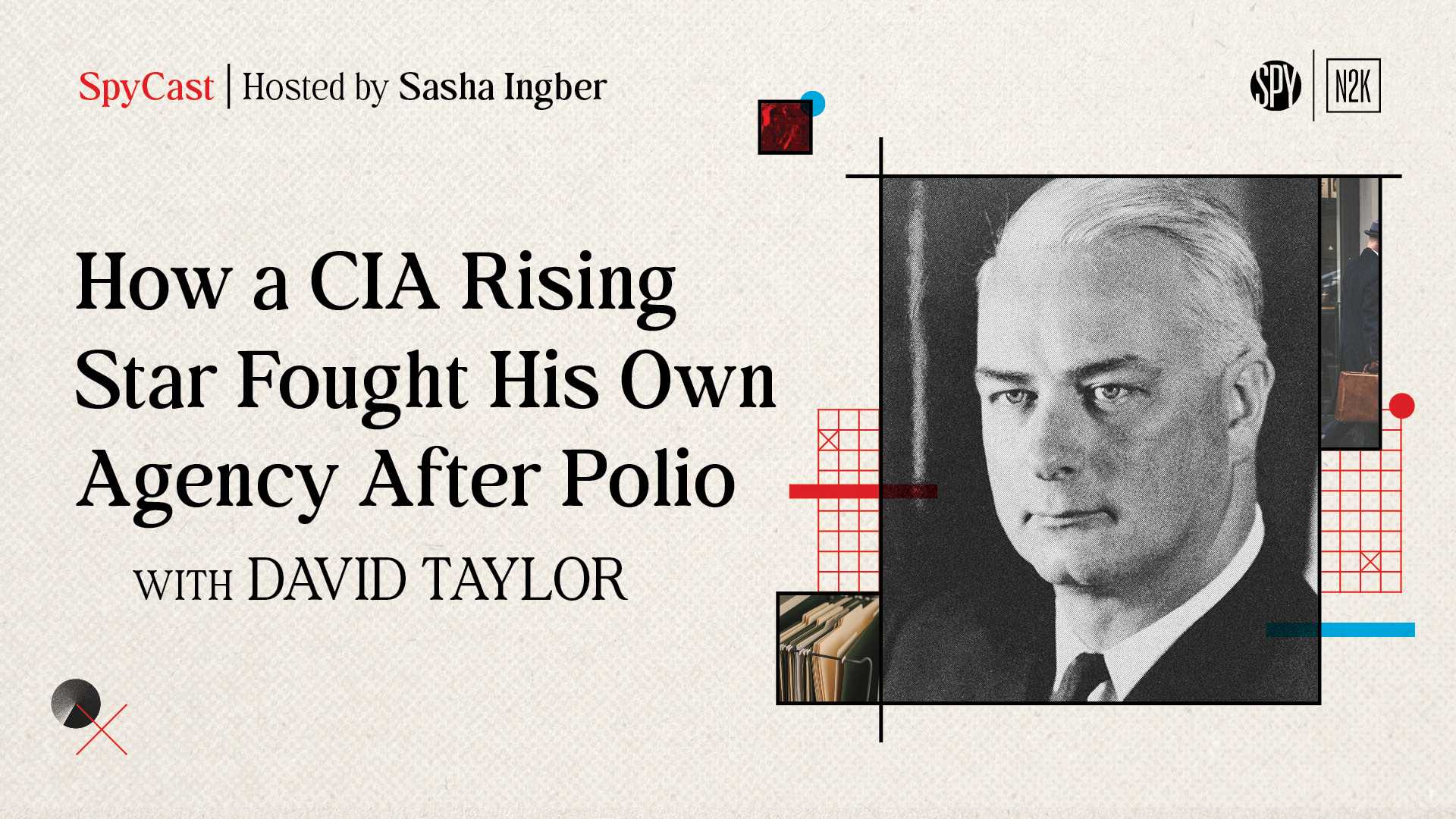


How a CIA Rising Star Fought His Own Agency After Polio


Sasha Ingber: Welcome to SpyCast, the official podcast of the International Spy Museum. I'm your host, Sasha Ingber, and each week I take you into the shadows of espionage, intelligence, and covert operations across the globe.
In the 1950s, Lyman Kirkpatrick had just been promoted to chief of operations in the CIA's clandestine service. He was 36 with a bright future ahead. And then what he thought was a cold turned out to be polio. And suddenly he saw his entire career trajectory derailed, not because of health issues, but because of restrictions that his agency was imposing on him for now being in a wheelchair. And he was determined to prove them wrong. He earned the nickname "Hell on Wheels," and he ended up landing top jobs, becoming number three at the agency and receiving prestigious awards for his service. Now, October was National Disability Employment Awareness Month, and author David Taylor joined me to talk about Lyman's work and life.
David, welcome to the show.
David Taylor: Thanks so much for having me, Sasha.
Sasha Ingber: Now, when I was preparing for this interview, I noticed that Lyman Kirkpatrick's life story and the fact that he won the CIA's prestigious Trailblazer Award have been taken down from the website. It's gone now. So it's all the more important that we are sitting here right now.
David Taylor: Thanks. Yes, I saw that too.
Sasha Ingber: So where does his intelligence career begin? He was a football player at Princeton. He was a journalist with US News and World Report. When does he get into the intel business?
David Taylor: Yes, he says in his writings that it was by accident. It was after he graduated from Princeton, he came to Washington and started working as a journalist. And then after the attack on Pearl Harbor, he wanted to join the Navy particularly, but he failed the colorblind test. And so it was soon after that, actually through a Princeton connection that he got contact with the Office of Strategic Services and met Colonel Donovan himself.
Sasha Ingber: Wild Bill Donovan.
David Taylor: That's right.
Sasha Ingber: And so I know that he ended up in Normandy before D-Day. He was giving briefings. Take us into that time.
David Taylor: Yes. So his first assignment, he was surprised and happy to be assigned to the London office of the OSS. And he was initially just a support liaison, and then he joined Omar Bradley's intelligent unit going to Normandy and the briefing team for that. And actually Bradley's briefer got sick, and so Lyman took up the daily briefing duty from June 1944, and for six months, the top US commanders were coming through that office and getting briefed every morning.
Sasha Ingber: And I know that he gets on the good side of General Patton who is leading the third army, known for its quick combat, now called the Army Central. And he apparently was so well-informed that Patton made a very particular joke about him.
David Taylor: That's right. After one briefing in the winter, they were looking at the Eastern Front trying to figure out when the Russians would advance. And Patton's only question after briefing was "When are the Russians going to start their advance?" And Lyman's team had done a case study on Russian offensives in the past and how they responded to lags and material and recognized that they would want to be able to take tanks across the Vistula river when it was frozen hard enough to do that.
And so he said the second week in January. And as it happened, the Russians advanced on January 11th. So the next time that Patton comes into the room for a briefing, he points to Lyman, says to Bradley, "Watch this guy. He must be a communist. He knew when the Russians were going to advance." So that was Patton's way of giving a compliment.
Sasha Ingber: This was when the Americans were waiting for the Russians to launch their offensive into Germany.
David Taylor: That's right. On the other side, yes.
Sasha Ingber: So after World War II ends, he joins this new organization that we now know as the CIA, and this is a time of great loss in the Asia theater, specifically in China. They're trying to build a resistance network to communism and Mao Zedong, trying to divert him from participating in the Korean War. Can you say more on what Lyman may have been doing?
David Taylor: He says that Donovan expressly wanted to come into that, and I know he wrote later about when they lost a number of the China operatives, but he doesn't say a lot about the operations that he was active in Asia per se.
Sasha Ingber: Okay. So what else is he doing?
David Taylor: So he gets recruited by Walter Bedell Smith, the CIA director at that time, to help with streamlining. So he's immediately kind of tasked with some of the managerial aspects, and he's traveling to the CIA offices from Europe, Asia, and really helping to streamline and modernize the agency.
Sasha Ingber: So he has a big job. There's a lot to manage if that's his remit. How does he get polio?
David Taylor: Yeah. He talks about that period as nearly two years of the most intense and stressful work that he'd ever had of his career. And so he was traveling intensely, and there was one meeting in Bangkok where there was a lot of friction between two of the offices being pared down. And in the wake of the Korean conflict, that was particularly a heated exchange, he's exhausted. He gets back to DC actually, and he probably in good measure from his both emotional and physical exhaustion was susceptible to polio, which at that time in 1952 was becoming increasingly an epidemic. My father was hit in the same wave of polio actually the next year in the Washington DC area also. And he also had suffered a lot of work stress. So I think that that combination of intense travel and stress left them both open to it.
Sasha Ingber: What was his rehabilitation like when he's in the hospital? What's going through his mind as he's just trying to get back to what he had?
David Taylor: Well, one of the first thing that's going through his mind is awareness of actually the paralysis setting in. And I think that's one of the scarier aspects is that he was aware his arm is not working, his leg's not working, and then he can barely lift his head. So I think that the onset of the paralysis is one of the kind of terrifying aspects of that disease. But I think when you come through, you start to realize that recovery is possible, that your drive towards getting back as much as possible is just relentless. So you become totally fixed on what is needed, really driving your body as much as you can to get back to normal.
Sasha Ingber: Now, he stepped away from the agency in July of 1952. I read a declassified letter that he wrote to the CIA director, Walter Bedell Smith, AKA Beetle. Quote, "I know I'm foolish to try and predict the future, but I feel more or less that I should be getting around in a wheelchair by the end of September and probably graduated to an outpatient status by November. I might also add that I'm quite hopeful that I will get back the full use of my legs, particularly in as much as I can feel some muscles and get some motion out of my legs already." He wanted daily logs. It's like you can feel that he is really, really itching to get back to his regular life at the CIA.
David Taylor: That's right. He really expected to be able to get back to his position.
Sasha Ingber: What was Lyman's process of getting strong enough to then be moved into a wheelchair?
David Taylor: In Lyman's case, he knew that the polio had affected mainly his limbs, his legs particularly. He was very involved in rehab in trying to counteract the paralysis that he had been experiencing for the first months during the fever and really get back to where he could take up his old responsibilities.
Sasha Ingber: Do we have a sense of his emotional state in a deeper sense? I mean, his entire trajectory now is called into question for no fault of his own.
David Taylor: Right. It was a period of intense disorientation and frustration at the time that it was taking to get back from the hospital. He was getting visits from the director, General Smith. He was getting a letter occasionally from FBI Director J. Edgar Hoover, who'd been liaising with his office saying, "I hope you'll get back soon." So he fully expected to get back as soon as he could, and it was frustrating that it was taking so long.
Sasha Ingber: So how did the CIA director respond to his illness?
David Taylor: Yeah, the CIA director, General Smith, as Lyman called him, came several times to his bedside, and that was no small thing because at that time it was polio, there was no vaccine, so visiting it, you had to get suited up like a hazmat, like going to visit a COVID patient in 2020. Smith didn't have a great bedside manner. He was a spiky man, but Smith was very engaged and encouraging for Lyman to get back. He said that, "I don't care about your legs. I need your brains to come back."
Sasha Ingber: Now he returned about eight months later. This is now March of 1953. The general who had been leading the agency is now out. In is Allen Dulles. He's just been there for about a month. What is it like when Lyman returns?
David Taylor: It's confusing. Lyman is welcome back. He has an office that he's welcome to. He's in a wheelchair and people are happy to see him back, but they're also very vague about his duties. He has a vague title, and he learns not by anyone telling him directly that Richard Helms has been confirmed as a permanent replacement in his former position.
Sasha Ingber: Now, he had thought that he was going to be leading covert operations and Helms goes on to not only take this job, but later become CIA director. Is he given a reason for this change?
David Taylor: He's not given a reason for the change, as it was all kind of word of mouth or held close to the chest. One CIA historian I spoke with said that it was just kind of known that if you were disabled in any way, you might get a desk job, but you would never have a operations job overseas. And that was the understanding apparently that they had. Lyman did find out there was a fitness report about him made up that Allen Dulles reviewed, and it said he could do anything, but he just couldn't travel.
Sasha Ingber: So that was where the line was drawn. That was the only restriction?
David Taylor: That's right, on his new job as Inspector General. And Lyman said, "Fine, I can travel in a wheelchair. I can travel. Not totally accessible, but I can definitely travel."
Sasha Ingber: Did he want to be Inspector General?
David Taylor: He adapted to that. That wouldn't have been his first choice, but he saw the need for the position. He saw the Inspector General's review of the agency was important, and that did involve travel, and you would have to go to the field offices to be able to see how they were actually operating and what needed to be reviewed.
Sasha Ingber: When we come back, David discusses Lyman's travels as Inspector General.
So even though Dulles has said, "You can't do anything that requires travel," he does travel and he goes to Latin America. What is he doing on these trips as the IG?
David Taylor: Within weeks of being told that he couldn't travel, he booked a trip that would take him throughout just about every country in Latin America. And he was visiting, especially in Mexico and Cuba, the offices, the operations and security.
Sasha Ingber: Why there? Right now we have such an emphasis on these same regions, these same countries. What was it that made him go to Latin America as opposed to back to the Asia Theater?
David Taylor: That's a great question. And he did set up to go to the Asia Theater next, but Latin America, obviously and Cuba, was already seeing the dissatisfied public and the Castro Revolution was in the works.
Sasha Ingber: So he's going on these trips. Is part of the incentive that he wants to prove that he can still do everything that everybody else can?
David Taylor: I'd say it's a twofold thing that he saw that it was necessary for the work, and yes, he wanted to prove that he could do these things.
Sasha Ingber: So what happens when he makes this trip to Cuba?
David Taylor: In 1956, he goes to Cuba and pays a visit to President Batista, and the ambassador helps pave the way for that visit. The formal front entrance has a big staircase, so the one accommodation to his wheelchair situation was they went by way of the back entrance where there was just two steps and his wheelchair could be brought up. But he had a letter from Secretary of State Dulles offering Cuba support in the anti-communist effort. And so they talked about that and the training that the US could provide to Cuban security forces focused on diffusing communism, not all public descent.
Sasha Ingber: Okay. Because this is a leader who would be overthrown by Fidel Castro in 1959, and he was a dictator himself, so he wasn't necessarily following the will of the people.
David Taylor: That's right. So Lyman was, in the days that he was helping to craft the training program, he was trying to gear it so that it would be focused on the communist threat and not simply be creating a security force that would be used to suppress public opinion.
Sasha Ingber: So how did it go with Batista?
David Taylor: Did not go well. The training just did not get well implemented, and that was a frustration.
Sasha Ingber: Okay. And I know I'm fast-forwarding here, but when the Bay of Pigs invasion happens in 1961, total failure to overthrow Castro, he then is tasked with investigating what went wrong. This report is held back for about three and a half decades. It doesn't get declassified until I think three years after he has died. What did he find in what went wrong?
David Taylor: Yeah, Lyman's Inspector General report on the Bay of Pigs was unsparing. He saw that the leadership of the agency had not been straightforward or clear with the White House and had not dedicated the resources to the operation to make it successful. So for example, there were cables saying that even Spanish language capability was requested and not responded to. So there were issues both at the operations level, but also at the top where they did not tell the president what he needed to know to make sure. They were assuming there would be military support, and that was not the assumption that the White House had.
Sasha Ingber: Right. Dulles said that if this report comes out, it's going to really harm the agency.
David Taylor: Yeah. Dulles had 19 of the 20 copies that had been printed, pulled back and destroyed. And so there was only one surviving copy.
Sasha Ingber: This must have put Lyman in a very bizarre situation that a lot of inspectors general have to feel, but because of the fact that he was restricted to a wheelchair, was there any concern that maybe he, amongst the critics, felt that he was being biased in his investigation? And I'm not saying that that would be a fair question, but was it a question that was asked?
David Taylor: Yeah, in my exchanges with the CIA historians about this, they saw that there had been internal discussion of Dulles and his deputy that maybe Lyman was biased because of his restricted duties due to his being in a wheelchair, and that maybe that colored his view and the report's view of the CIA's actions. I don't know that that internal opinion that he had a personal bias actually does hold up when decades later looking at the report. It seems pretty accurate.
Sasha Ingber: And so the goal of an Inspector General holding the agency accountable was really watered down by their own assumptions about him and his disability.
David Taylor: You could say that, particularly in that instance.
Sasha Ingber: And as Inspector General, I know that he investigated some very disturbing situations inside the agency. The death of military scientist Frank Olson, who dropped out of a window and killed himself after being secretly dosed with LSD in a subproject of MKUltra. There was a CIA officer who was asked to assassinate the democratically elected leader of the Congo, Patrice Lumumba, poisoning toothpaste, and Lyman reportedly very much opposed this. These were some of the things that he was seeing from the inside as Inspector General.
David Taylor: That's right. And he took stand on both of those issues. In the case of MKUltra, he recommended that the staff responsible be disciplined. That didn't happen. And he also spoke out against the plan to assassinate Lumumba. That didn't go forward, perhaps with his voice being important to that.
Sasha Ingber: Yeah. Although the killing of Lumumba still happened and the station chief was involved in that. So my guess is he wasn't necessarily a popular guy.
David Taylor: That's right. And he accepted that the Inspector General would not be a popular guy, that was part of the remit was to be impartial and to call him as he saw him.
Sasha Ingber: Now, he was part of a report that led to the creation of the Defense Intelligence Agency in 1961. How did that come about?
David Taylor: At the end of the Eisenhower administration, the White House commissioned a joint study for the Intelligence Agency going forward, and Lyman became the lead on that. And so he recommended a streamlining. The aim was to create the new agency to streamline and reduce duplication within the Defense Department. So when that was formed in 1961, he was called in some ways the father of the Defense Intelligence Agency, which he commented on roofily, but he was kind of pleased by that.
Sasha Ingber: And there's a quote that I particularly found amusing that he said, this predates this by about 10 years, but he talks about how the CIA has become very bureaucratic saying quote, "We're getting too embedded in paperwork. There are times when I think our great impact on the Russians could be to bundle up most of our paper and drop it on them."
David Taylor: Oh, that's a great quote. I actually haven't seen that one. He saw it as a way of modernizing the agency, bringing it into the 1960s, a new era for intelligence.
Sasha Ingber: And he took some of those skills of just saying whatever he felt to various presidents from Eisenhower to JFK, I believe Johnson after that. What was he saying to them and why did so many presidents turn to him?
David Taylor: I think they turned to him partly because he had this impartial view and a way of looking at organizations as a whole, so he could give a sense of how the agency could be better at what it did. He wasn't as much of an insider as say the director and his deputies. He knew the agency inside and out literally, and so he could speak to its interior strengths, but he also could create the distance and say, "These are the weaknesses that I see."
Sasha Ingber: Did he ever experience a moment of questioning why he was still inside when there were moments where he was treated differently after having gone through the affliction of polio and then being wheelchair bound?
David Taylor: He was interviewed as he retired, and he talks about the surprise he had of being viewed differently. He felt like he could drive, he could mow his lawn, he could do so many things. He had the sense of his personal agency, so he was kind of shocked when he would be referred to as disabled or handicapped. It was a surprise for him to deal with that.
Sasha Ingber: And when he left the agency in 1965, he goes on to teach at Brown University, which school that he had attended. He writes this memoir, he lives into the 1990s. This is really more speculative, but how might the agency have been different if he had been able to take on the role that had been first given to him, where maybe instead of Helms, he would have become the CIA director?
David Taylor: Right. I mean, I think that's a question about an alternative history that remained very vivid for him because he could see that he was on that path. I think what maybe he gained by not being within that same chain of promotion was perhaps a sense of the wider view of maybe how outside agencies or outside possibilities could be brought to bear within the agency. So in some sense, by being taken out of that kind of inevitable promotion, it maybe gave him a wider perspective.
Sasha Ingber: What was most surprising to you as you started piecing together parts of his life and career?
David Taylor: I think one of the things that was really surprising to me was how, frankly, he wrote about it in a book called The Real CIA that came out in 1967, which kind of aimed towards countering the James Bond image of the agency and wanted to give the real inside story. But the extent to which he gave is practically a memoir embedded in that book that he talks about his experience with polio, his, again, his frank self. It's a little bit broken up across several chapters, and I think that kind of speaks to the trauma that maybe he experienced. But he talks very frankly about getting into the hospital, that process, what his thoughts were, about getting back to work, and the visits that he had from people in a way that I wouldn't have expected to see in that book.
Sasha Ingber: Why did you decide to tell his story? What was it that made you start embarking on this research?
David Taylor: I was really interested in Lyman's experience for two reasons. For one thing, it resonated with my father got polio around the same time. He was an engineer in the military. He could also see his career, an alternative career becoming a general in the Corps of Engineers. But as it turned out, he also was a research manager. He said that he gained greater perspective by his actual experience of being taken out of the chain of command. So I became interested in Lyman because of his truth-telling ability. Also, the fact that his story is not as well known. As you mentioned, it's been taken down from the CIA's website, and I think that is a loss, that I think that type of story is important to get both for the strength of the agency. Other places on the site says "We want people of all abilities." So I think for the agency itself, it's good to know what the story brings to the history of it.
Sasha Ingber: And when it comes to your father, he had actually been involved in the Manhattan Project.
David Taylor: That's right. He had been a West Point graduate, one of the several cohorts who received top secret orders to come back in 1946 and be assigned to the Manhattan division in New Mexico, and that changed his career. He was part of the team that was transitioning the capacity for building and testing nuclear weapons. He contracted polio in 1953. He was a military officer, even at age 28, he was a major, and so he saw himself as having a career in the military. So he was very shocked to have to leave his military career as a result of polio.
Sasha Ingber: And your father ended up in an iron lung. Did your father know about people like Lyman who had gone through their own ordeal and stayed in their agencies and were still kind of killing it?
David Taylor: The communications at that time and around illness as serious as polio, there was a lot of secrecy. So I don't think that my father reconnected with a community of polio survivors until the post-polio syndrome, which often hit 40 years later.
Sasha Ingber: And like Lyman, your father decided that he was going to continue doing the work.
David Taylor: Yes. He returned after rehab also in the mid 1950s, he returned to a civilian job with the Army's Atomic Energy Commission, and he also insisted he could travel, and he did travel. He was a nuclear engineer. Actually, he got approached by a Soviet attache who wanted to explore a paper that he had published and ask about the material needed for that, the equipment.
Sasha Ingber: Sounds a little bit like Cold War espionage potentially.
David Taylor: Yeah, it was kind of a brazen attempt by this attache named Yuri Krylov who became famous within the FBI for being like Mr. Brazen. He would've approached a number of people before he was finally sent back as a result in early 1957.
Sasha Ingber: Well, when I think about the reporting on the intelligence community in the last year or two, what I've been hearing is that people who have wheelchairs, who have vision problems, they have been nervous to speak out, fearing that they'll fall into this sort of DEI black hole, that it will have a ramification on their careers. What would you say to them and what would you say to leadership who really can impact their careers?
David Taylor: Yeah, I mean, I think it is important for people to not shy away from the request for accommodation for what they need to do their job well. And I think that's the same question that the managers responding to them should be thinking about. This is what accomplishes the mission best. It's a chilling atmosphere that it requires a lot of resolve and better communication to get past the effect of that chilling effect. At the same time, personnel laws and regulations are in place that should support them in making those requests. So hopefully we'll get beyond this immediate time of that effect and we'll get to recognition of what's needed for the agency to do its best.
Sasha Ingber: You think that we'll see Lyman's story back on the website?
David Taylor: At some point, I'd certainly expect to see Lyman's story in its full color on the website again.
Sasha Ingber: David, thank you so much for coming in.
David Taylor: Thanks for having me.
Sasha Ingber: Thanks for listening to this episode of SpyCast. If you liked the episode, give us a follow on Apple, Spotify, or wherever you get your podcasts and leave us a rating or a review. It really helps. If you have any feedback or you want to hear about a particular topic, you can reach us by email at spycast@spymuseum.org. I'm your host, Sasha Ingber, and this show is brought to you by N2K Networks, Podville Media, and the International Spy Museum in Washington, DC.


